Κυριακή 25 Σεπτεμβρίου 2022

Isthmus morphology influences debridement efficacy of activated irrigation: a laboratory study involving biofilm mimicking hydrogel removal and high‐speed imaging

alexandrossfakianakis shared this article with you from Inoreader

Abstract

Aim

Little is known about the influence of isthmus morphology on the debridement efficacy of activated irrigation. The aim of this study was to investigate the influence of isthmus morphology on the debridement efficacy of laser-activated irrigation (LAI), EDDY and needle irrigation (NI), and to explain the methods of isthmus cleaning by LAI and EDDY.

Methodology

Four root canal models (apical diameter: 0.30 mm, taper: 0.06, curvature: 23°, length: 20 mm) were produced by CAD-CAM with different isthmus morphologies: long-wide (4 mm; 0.4 mm), long-narrow (4 mm; 0.15 mm), short-wide (2 mm; 0.4 mm) and short-narrow (2 mm; 0.15 mm). The isthmuses were filled with a hydrogel containing dentine debris. The canals were filled with irrigant and models were assigned to the following irrigation protocols (n=240): needle irrigation (NI) with a 30G needle, Eddy, and LAI (2940 nm Er:YAG-laser, 15 Hz, 40 mJ, SWEEPS, tip at the canal entrance). Standardized images of the isthmuses were taken before and after irrigation, and the amount of removed hydrogel was determined using image analysis software and compared across groups using Kruskal-Wallis test followed by Dunn's multiple comparison. Visualization of the isthmus during activation was achieved using a high-speed camera. The pattern and speed of the flow in the isthmus as well as transient and stable cavitation were analysed using imaging software.

Results

LAI, EDDY and NI removed more hydrogel in short-wide isthmuses than in narrow isthmuses (P<0.001). LAI and EDDY removed more hydrogel than NI in every isthmus configuration (P<0.001). EDDY showed eddies and stable cavitation, and LAI showed transient cavitation at each pulse, and pulsed horizontal flow with the highest particle speed in closed short isthmuses.

Conclusions

Isthmus morphology influences debridement in all irrigation groups. Short-wide isthmuses were the easiest to clean while narrow isthmuses were the most challenging to clean. Width seems to be a more critical anatomical parameter than length. LAI and EDDY resulted in the greatest biofilm removal and performed better than NI. EDDY produced eddies and stable cavitation in the isthmus, and LAI showed transient cavitation and pulsed horizontal flow.

View on Web

Optimal Timing of the Salivary Pepsin Test for the Diagnosis of Laryngopharyngeal Reflux

alexandrossfakianakis shared this article with you from Inoreader
Optimal Timing of the Salivary Pepsin Test for the Diagnosis of Laryngopharyngeal Reflux

Salivary pepsin testing combined waking, 1 h and 2 h after breakfast and lunch, and 1 h after dinner has almost the same diagnostic value as MTPSPT, and testing at these time points can be an effective method for diagnosing LPR.


Objective

To investigate the optimal time point for diagnosing laryngopharyngeal reflux (LPR) through combining 24-h hypopharyngeal-esophageal multichannel intraluminal impedance-pH (24-h HEMII-pH) monitoring and the multi-time point salivary pepsin test (MTPSPT).

Study Design

Prospective uncontrolled trial.

Method

Patients with and without LPR symptoms were included as the test group and the control group, respectively. The patients in the test group underwent 24-h HEMII-pH and MTPSPT. The results of 24-h HEMII-pH were used as a diagnostic criterion for LPR, and the diagnostic value of salivary pepsin tests performed at different time points was compared by receiver operating characteristic (ROC) analysis.

Results

A total of 153 patients were included. Based on 24-h HEMII-pH, the positive rate of LPR in the test group of patients was 84.00%. In the control group, only one person (3.57%) had a positive salivary pepsin test result. The area under the curve (AUC) of the MTPSPT was 0.827. In addition, we separately calculated the AUC of the combined salivary pepsin test at different time points, and found good diagnostic value (AUC = 0.799) when the test was combined with the waking, 1 and 2 h after breakfast and lunch, and 1 h after dinner tests. However, when the number of tests were further increased, the diagnostic value did not improve significantly.

Conclusion

Salivary pepsin testing combined with waking, 1 h and 2 h after breakfast and lunch, and 1 h after dinner has almost the same diagnostic value as MTPSPT, and testing at these time points can be an effective method for diagnosing LPR.

Level of Evidence

3 Laryngoscope, 2022

View on Web

Co-administration of Oral Cholera Vaccine with Oral Polio Vaccine among Bangladeshi Young Children: A Randomized Controlled Open Label Trial to Assess Interference

alexandrossfakianakis shared this article with you from Inoreader

cid_ogimage.png

Abstract
Background
Cholera remains a public health threat for low- and middle-income countries, particularly in Asia and Africa. ShancholTM, an inactivated oral cholera vaccine (OCV) is currently in use globally. OCV and oral poliovirus vaccines (OPV) could be administered concomitantly but the immunogenicity and safety of coadministration among children aged 1-3 years is unknown.
Method
We undertook an open-label, randomized, controlled, inequality trial in Dhaka city, Bangladesh. Healthy children aged 1-3 years were randomly assigned to one of the three groups: bivalent OPV (bOPV)-alone, OCV-alone, or combined bOPV + OCV and received vaccines on the day of enrollment and 28 days later. Blood samples were collected on the day of enrollment, day 28, and day 56. Serum poliovirus neutralizing antibodies and vibriocidal antibodies against V. cholerae O1 were assessed using microneutralization assays.
Results
A total of 579 children aged 1‒3 years were recruited, 193 children per group. More than 90% of the children completed visits at day 56. Few adverse events following immunization were recorded and were equivalent among study arms. On day 28, 60% (90% Confidence interval, 53%-67%) and 54% (46%-61%) of participants with co-administration of bOPV + OCV responded to polioviruses type 1 and 3 respectively, compared to 55% (47%-62%) and 46% (38%-53%) in the bOPV-only group. Additionally, >50% of participants showed a ≥4-fold increase in vibriocidal antibody titre responses on day 28, comparable to the responses observed in OCV-only arm.
Conclusions
Co-administration of bOPV and OCV is safe and effective in children aged 1-3 years and can be cost-beneficial.
View on Web

Association of growth patterns during infancy and puberty with lung function, wheezing and asthma in adolescents aged 17.5 years: evidence from ‘Children of 1997’ Hong Kong Chinese Birth Cohort

alexandrossfakianakis shared this article with you from Inoreader

m_dyac182f1.jpeg?Expires=1727190020&Sign

Abstract
BackgroundRapid growth is related to adverse respiratory outcomes although possibly confounded or limited by growth modelling methods. We investigated the association of infant and pubertal growth with lung function, wheezing and asthma in a non-Western setting.
Methods
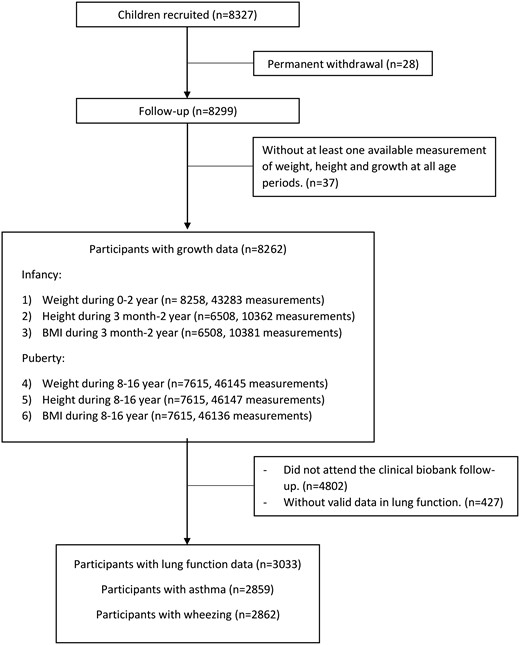
In Hong Kong's 'Children of 1997' Chinese birth cohort (n = 8327), weight during infancy and weight, height and body mass index (BMI) during puberty were modelled using a super-imposition by translation and rotation model to identify (larger or smaller) size, (earlier or later) tempo and (slower or faster) velocity. Sex-specific associations with forced vital capacity (FVC), forced expiratory volume in the first second (FEV1), FEV1/FVC (Global Lung function Initiative z-score) and self-reported wheezing and asthma at ∼17.5 years were assessed.
Results
For each fraction higher than average weight growth velocity during infancy, FVC w as higher in boys (0.90 SD, 95% CI 0.35; 1.44) and girls (0.77 SD, 95% CI 0.24; 1.30), FEV1/FVC was lower (–0.74 SD, 95% CI –1.38; –0.10) and wheezing was higher (odds ratio 6.92, 95% CI 1.60; 29.99) in boys and an inverse association with FVC was observed for tempo but not for size. Associations for weight growth velocity in puberty were similar but weaker. Greater size and higher velocity of BMI growth was associated with higher FVC, lower FEV1/FVC and higher asthma and wheezing risk.
Conclusion
Accelerated infant and pubertal weight growth were associated with disproportionate lung size and airway growth, and higher risk of asthma; optimizing early-life growth patterns could be important.
View on Web

Πέμπτη 22 Σεπτεμβρίου 2022

Longitudinal Effects of Base of Tongue Concurrent Chemoradiation Therapy in a Pre‐Clinical Model

alexandrossfakianakis shared this article with you from Inoreader
Longitudinal Effects of Base of Tongue Concurrent Chemoradiation Therapy in a Pre-Clinical Model

We present a clinically relevant animal model quantifying the effects of concurrent chemoradiation therapy (CCRT) on tongue strength and elasticity over time. This study demonstrates an increasing difference in tongue strength over time between control animals and those exposed to CCRT. Tongue elasticity was not significantly affected by CCRT, suggesting that changes in strength may not be caused by fibrosis during the time period studied.


Background/Objectives

Base of tongue (BOT) dysfunction is common following oropharyngeal concurrent chemoradiation therapy (CCRT). We present a clinically relevant animal model quantifying the effects of CCRT on tongue strength and elasticity over time.

Methods

Fifty-three male and 53 female Sprague–Dawley rats were randomized to control or experimental groups. Experimental animals received cisplatin, 5-fluorouracil, and 5 fractions of 7 Gy directed to the BOT. Controls received no intervention. At 2 weeks, 5 months, or 10 months after CCRT, animals underwent non-survival surgery to measure twitch and tetanic tongue strength, which were analyzed using multivariate linear mixed effects models. Tongue displacement, a surrogate for tongue elasticity, was also determined via stress–strain testing and analyzed via a multivariate linear mixed effects model.

Results

Reporting the combined results of both sexes, the estimated experimental group mean peak twitch forces became more divergent over time compared to controls, being 8.3% lower than controls at 2 weeks post-CCRT, 15.7% lower at 5 months, and 31.6% lower at 10 months. Estimated experimental group mean peak tetanic forces followed a similar course and were 2.9% lower than controls at 2 weeks post CCRT, 20.7% lower at 5 months, and 27.0% lower at 10 months. Stress–strain testing did not find CCRT to have a significant effect on tongue displacement across experimental timepoints.

Conclusions

This study demonstrates an increasing difference in tongue strength over time between controls and animals exposed to CCRT. Tongue elasticity was not significantly affected by CCRT, suggesting that changes in strength may not be caused by fibrosis.

Level of Evidence

NA Laryngoscope, 2022

View on Web

Cetuximab-Based vs Carboplatin-Based Chemoradiotherapy for Patients With Head and Neck Cancer

alexandrossfakianakis shared this article with you from Inoreader

jamanetwork.com

This cohort study compares survival with cetuximab-based and carboplatin-based chemoradiotherapy in locally advanced head and neck squamous cell carcinoma.
View on Web

Validation of Pain Catastrophizing Scale on Breast Cancer Survivor

alexandrossfakianakis shared this article with you from Inoreader

Abstract

Introduction

Pain Catastrophizing Scale (PCS) is the most used scale to measure pain catastrophizing. In breast cancer survivors (BCS), pain catastrophizing is related to upper-limbs dysfunction and disability. This study aimed to assess the internal consistency, internal structure and convergent validity of the Spanish version of the PCS in Spanish BCS

Material and Methods

BCS were recruited from the service of Medical Oncology of the University Clinical Hospital Virgen de la Victoria, in Málaga (Spain). The psychometric properties were evaluated with analyses factor structure by maximum likelihood extraction (MLE), internal consistency, and construct validity by confirmatory factor analysis (CFA).

Results

Factor structure was three-dimensional, and one item was removed due to cross-loading. The new 12-items PCS showed a high internal consistency for the total score (α=0.91) and a good homogeneity, and CFA revealed a satisfactory fit. PCS showed an acceptable correlation with FACS (r=0.53, p<0.01)

Conclusion

PCS is a valid and reliable instrument to evaluate pain catastrophizing in Spanish BCS. This tool may help clinicians in the management of pain by assessing pain and by measuring the effect of interventions.

View on Web

Δημοφιλείς αναρτήσεις